- Science
Naked Photo-Bombing Comet Found in Public Image
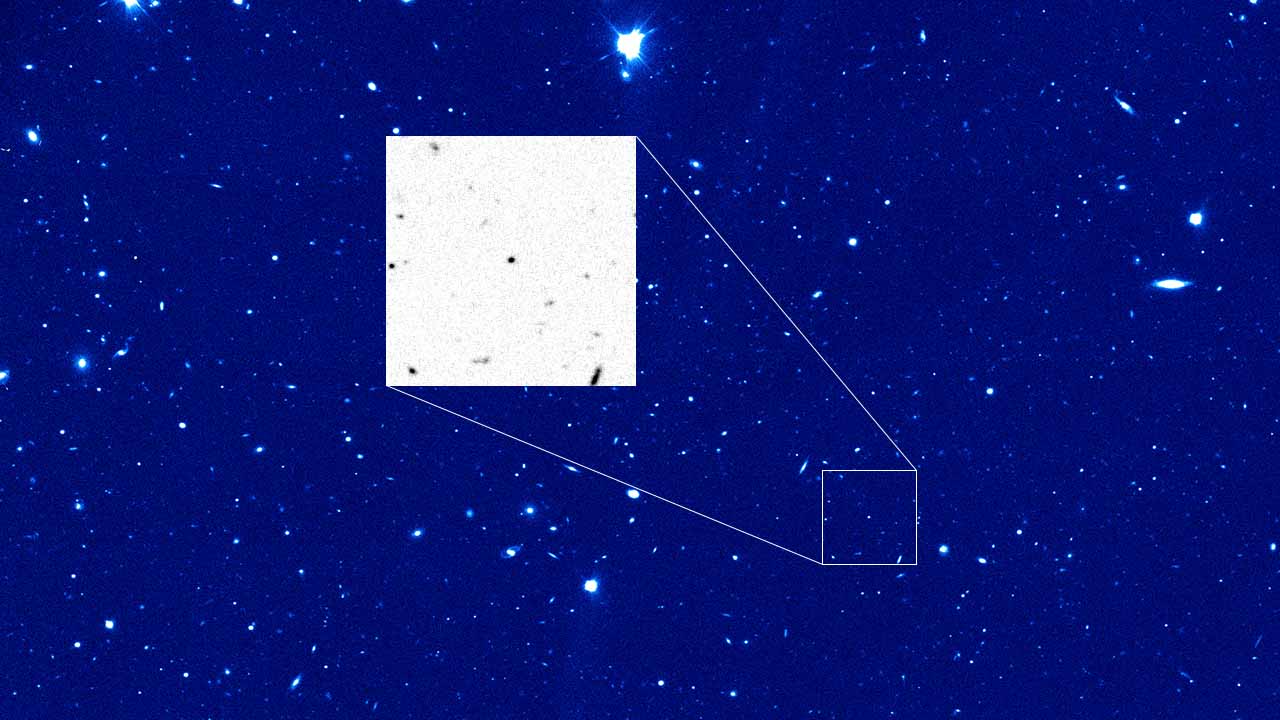
Sometimes images get released before anyone realizes they have been photo-bombed; meaning that something unexpected showed up in the background. A team of researchers found a naked photo-bombing comet in an image from publicly available archival data from the Subaru Telescope, resulting not in mirth, but in serious scientific discoveries.
To better understand comets, astronomers need direct observations of the nucleus, the central part of the comet. But as a comet approaches the Sun, the nucleus heats up and releases gas which forms a cloud known as a coma which obscures the nucleus. In order to observe a comet denude of its coma, the comet must be observed while it is still far away from the Sun, which means the comet will be dim. It requires a very large telescope, like NAOJ’s Subaru Telescope with an 8.2-m diameter primary mirror, to successfully capture such a faint, distant comet.
The Subaru Telescope has produced a vast collection of publicly available images covering large areas of the sky. Although these observations were originally designed for other scientific goals, the images can also contain unexpected Solar System objects, making the archive a valuable resource for new discoveries. A team including scientists from the University of Occupational and Environmental Health, Kyoto Sangyo University, and the National Astronomical Observatory of Japan searched the archive for such chance discoveries. Thanks to the very wide field of view on the Subaru Telescope, approximately the size of nine full-moons on the sky, and the telescope’s good sensitivity, the team was able to find images containing the naked photo-bombing Comet 28P/Neujmin at a distance of more than 10 astronomical units from the Sun, farther than from the Sun to Saturn. By analyzing how sunlight is reflected from the surface of the nucleus, the team was able to determine important similarities and differences between Comet 28P/Neujmin and asteroids, which do not exhibit cometary activity.
By applying the same observational approach to look for more naked photo-bombing comets in the future, researchers hope to gain a better understanding of how the surface structures of cometary nuclei have evolved over the history of the Solar System, ultimately providing new insights into how Solar System bodies formed and evolved into the objects we see today.
Detailed Article(s)
Subaru Telescope Archive Data Reveal Unexpected Surface Properties of a Comet
Subaru Telescope
Release Information
Researcher(s) Involved in this Release
- Takafumi Ootsubo (University of Occupational and Environmental Health, Japan)
- Hideyo Kawakita (Kyoto Sangyo University)
- Tadafumi Takata (National Astronomical Observatory of Japan)
- Tsuyoshi Terai (Subaru Telescope)
- Toshihiro Kasuga (Nishi-Harima Astronomical Observatory, University of Hyogo)
Coordinated Release Organization(s)
- National Astronomical Observatory of Japan, NINS
- Kyoto Sangyo University
Paper(s)
- Ootsubo et al. " Opposition effect of comet 28P/Neujmin observed with Subaru Hyper Suprime-Cam", in The Publications of the Astronomical Society of Japan, DOI: 10.1093/pasj/psag088